
Grisoco AI Sells Smart Contract Audits by the Contract, and Checks Agent Payments
Grisoco AI Sells Smart Contract Audits by the Contract, and Checks Agent Payments
As of 2026-10-20, grisoco.com describes a pay-per-contract automated audit and a rule-based allow, warn or block check for AI agent payments, while warning that it is no certification and will miss issues.
 Theo AnandTechnology Columnist
Most security vendors bury the bad news. Grisoco AI puts it on the page: its automated audit is not a certification, has no human reviewer, and will miss issues, including critical ones. That candor is the most interesting thing about a product that otherwise wants to turn a smart contract review into a checkout button.
A caution before going further. Everything below comes from grisoco.com as it read on 2026-10-20. These are the company's own claims, not independently reported news, and I found no benchmark or outside evaluation in the material I reviewed. What interests me is the mechanism, and the packaging.
An audit as a checkout
You upload Solidity or DAML source, or pull it from a public GitHub repo, according to the site. Deterministic tools run over it in isolation while an AI review runs alongside. Each finding, the site says, is verified, deduplicated and scored into one report. Then comes the part borrowed from human audit firms: you fix, accept the risk or dispute each finding across rounds until the case closes.
You can also push back on AI-sourced findings, asking for a proof of concept or arguing a false positive, and receive a reasoned verdict. That is sensible design. The weakest property of AI review is confident noise, and a dispute loop makes the noise answer for itself. Whether it works is something the page cannot settle.
 Grisoco AI's workspace: automated tools and an AI reviewer read a contract, and every finding is checked before it reaches the report. Screenshot: grisoco.com
The commercial wrapper is the real novelty. Per the pricing page, audits are priced per contract: no subscription, no tiers. A case with several contracts costs that many contracts times the price. The page, at least in the excerpt I saw, gives no figure. Checkout is one MetaMask confirmation, no card required, and the site pitches the workspace as the fastest way to judge whether the report is worth the price.
It also promises no cheaper tier that quietly skips the AI review. That is the whole product logic: one unit, one price, everything runs.
The agent payment check
The newer piece, labelled 'New' on the homepage (no launch date given), is the Agent Transaction Check. The problem it describes is real in outline. A person paying a merchant looks at a wallet screen. An agent paying on its own, the site argues, trusts whatever transaction it was handed.
The agent states its intent (token, amount, recipient). The service runs the transaction against the live chain and returns allow, warn or block in one API call, with a reason for each check. Any failed check means block; otherwise any warning means warn; otherwise allow.
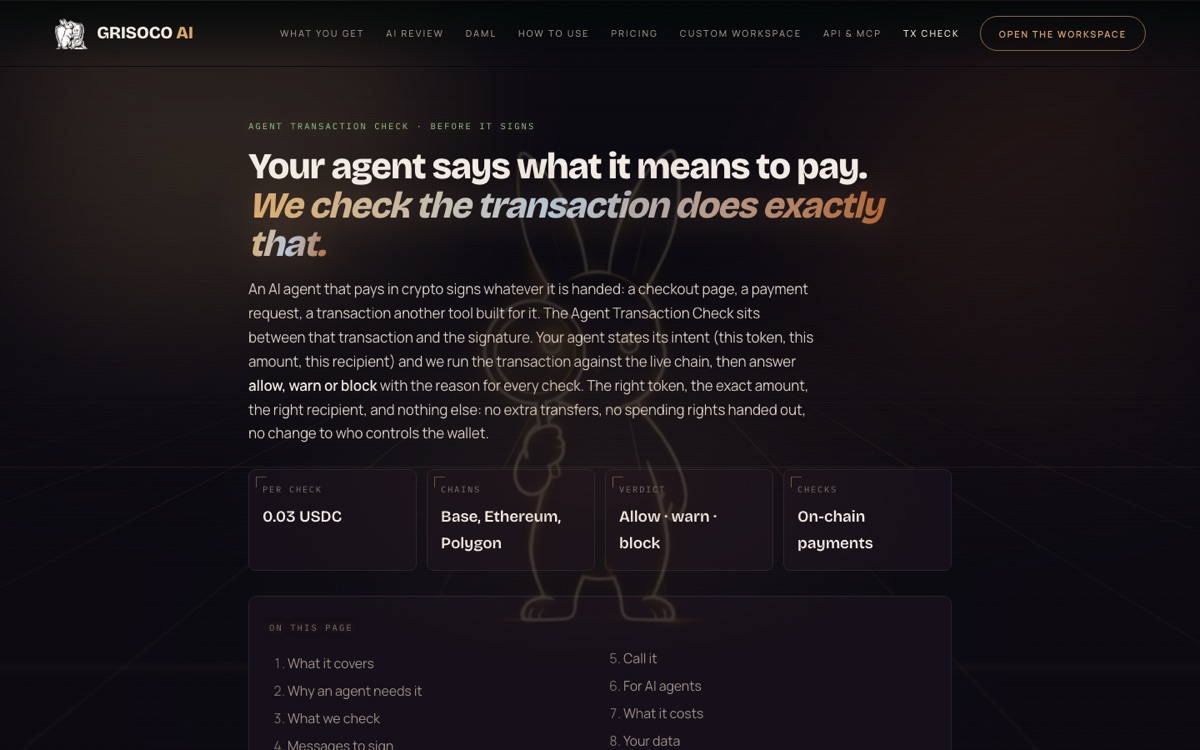 The Agent Transaction Check sits between an AI agent and its signature, answering allow, warn or block for each payment. Screenshot: grisoco.com
Two choices stand out. First, it is rule-based, not a model: the same transaction and intent always get the same verdict, and nothing the agent was shown can talk its way past it. In a field bolting a language model onto everything, a fixed comparison is refreshingly boring. Boring is exactly what you want between an agent and a signature.
Second, the scope is narrow. It covers only token payments on Base, Ethereum or Polygon, as a transaction or a gasless x402 signed message. Other request types are refused uncharged, and a transaction that does more than the stated payment, such as a swap, deposit or mint, is blocked.
Optional policy limits (a maximum amount, allowed tokens, allowed recipients) add a second fence. Payments routed through a router or smart wallet still match, the site says, since what counts is what leaves the sender and what reaches the recipient.
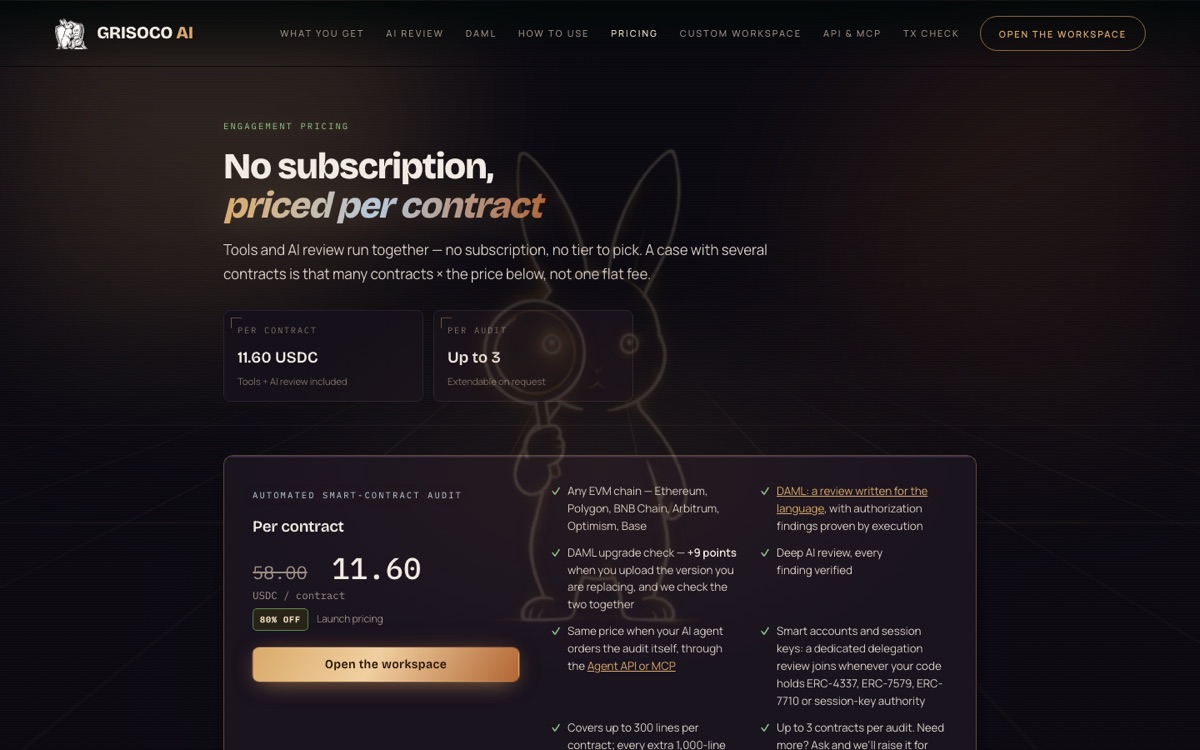 Pricing is per contract rather than a subscription, at launch pricing at the time of writing. Screenshot: grisoco.com
A sample response shows a block verdict and a charge of 3 cents. That is one sample, not a confirmed price; the pricing page says only 'one flat price per verdict', drawn from the same account balance as audits.
The delegation review
Also labelled 'New', again undated, is a delegation review for code holding ERC-4337, ERC-7579, ERC-7710 or session-key authority. The worry is that an agent's grant can be stretched: a bigger spend, a later expiry, a contract outside its scope. The site's example is a limit applied to the first call in a batch while later calls run unchecked. These are plausible failure classes, and it is notable that they get a dedicated review rather than a line in a generic checklist.
DAML and the custom route
A separate DAML/Canton review uses four risk axes. Only authorization findings are proven by execution, the site says, and the report marks which findings can be reproduced. The package must build first, so code using contract keys, removed in Daml 3.x, will not build. This review is described as taking minutes; no timing is given for EVM reviews. A custom workspace, built around a customer's own invariants, starts with a callback request.
The disclaimer that matters
Back to that candor. The site says no audit of any kind can prove a contract bug-free, and advises having a qualified engineer review every finding and engaging a professional audit firm before deploying a contract that holds significant value.
This is a fast, metered first pass, not a seal of approval.
Read that as the true product definition.
Background, and what we cannot say
For context, a TechTarget explainer (2026-04-24) defines smart contracts as self-executing programs and notes many newer platforms are EVM compatible. CoinDesk (2026-06-20) reported researchers saying AI security tools may lower audit costs and change what counts as reasonable due diligence, while cautioning that AI cannot replace human judgment. Neither, in the excerpts provided, mentions Grisoco.
The open questions are large. No source names who operates Grisoco or who its customers are. There is no per-contract price, no confirmed per-check price, no launch dates, and no accuracy or false-positive data. Until those exist, the sensible reading is the site's own: a useful-sounding tool, honestly labelled, that still asks you to bring a human.