
How FreeRide Switches Between Free AI Providers, and Where It Stops
How FreeRide Switches Between Free AI Providers, and Where It Stops
By its own pages as of 2026-10-20, FreeRide is a local program that holds your own free API keys and hops between providers, which explains both its promise of a free coding assistant and its limits.
 Theo AnandTechnology Columnist
A coding assistant that costs nothing and never stops is the kind of promise I read twice. So here is how FreeRide says it works, and where the same pages say it stops.
A note on sourcing first. Every claim below comes from the project's own pages (free-ride.xyz and the ridex page on GitHub), all dated 2026-10-20. I have not tested the software, and none of the sources is an independent review. This is not a launch story either: no page documents a dated release.
A switchboard on your own machine
AI coding assistants such as Claude Code, OpenAI Codex, Gemini CLI, Aider and Continue normally talk to one company's servers. Several AI providers offer free tiers, meaning limited free use, and each cuts you off at its limit. When that happens, says the About page, your assistant simply stops until the quota resets.
FreeRide describes itself as a lightweight Python program, a daemon, that runs on your computer. You point your assistant at a local address (localhost:11343, per the About page) instead of a provider's website. FreeRide then sends each request to one of the free providers you have set up. The About page lists OpenRouter, Groq, NVIDIA NIM, Cloudflare Workers AI, HuggingFace, Cerebras and a local Ollama install. If one provider hits a rate limit or runs out of quota, FreeRide moves to the next, and the assistant, the page says, never sees the error.
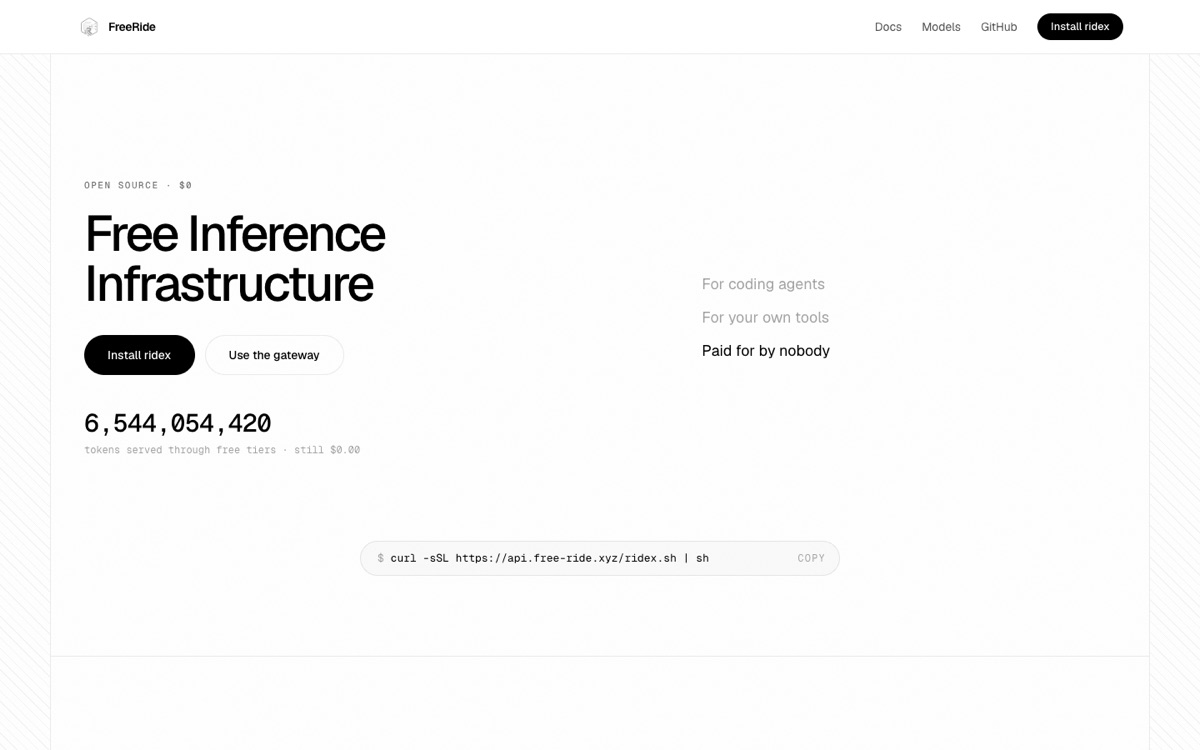 FreeRide's homepage: one install command, and a running count of tokens served through free tiers. Screenshot: free-ride.xyz
That mechanism is the clever bit. FreeRide speaks both the OpenAI Chat Completions format and the Anthropic Messages format, so the pages say existing tools need no code changes. The switching logic lives in one place instead of being rebuilt inside every tool.
Your keys, not theirs
On one point the pages are emphatic: you bring the keys. The developer page says FreeRide does not provide them, and the About page says it does not issue keys, create accounts or host a shared key pool. You sign up with the providers yourself, then run freeride config to enter what you have. One key is enough to start, the About page says, more improve coverage, and keys stay on your machine.
Installation, per the developer page, is a curl script, or pip or uv with the package freeride-gateway. You then attach an agent with a command such as freeride run claude, or freeride bind aider for older tools. The home page says the first run asks for a single free key.
When a provider fails
The home page lays out the cooling-off logic. A candidate that fails is marked for five minutes, so the next attempt starts from a model that is presumably healthy. Launchd and systemd keep the gateway alive, the page adds, and it restarts within seconds if killed.
Then the honest limit. When every candidate is cooling, the gateway returns a structured 503, an error meaning the service is unavailable. The developer page says the JSON body names which providers were exhausted. The home page frames this as leaving your own retry logic in charge.
The assistant is exactly as reliable as the free tiers behind it.
Switching stretches your free allowance. It cannot create new capacity.
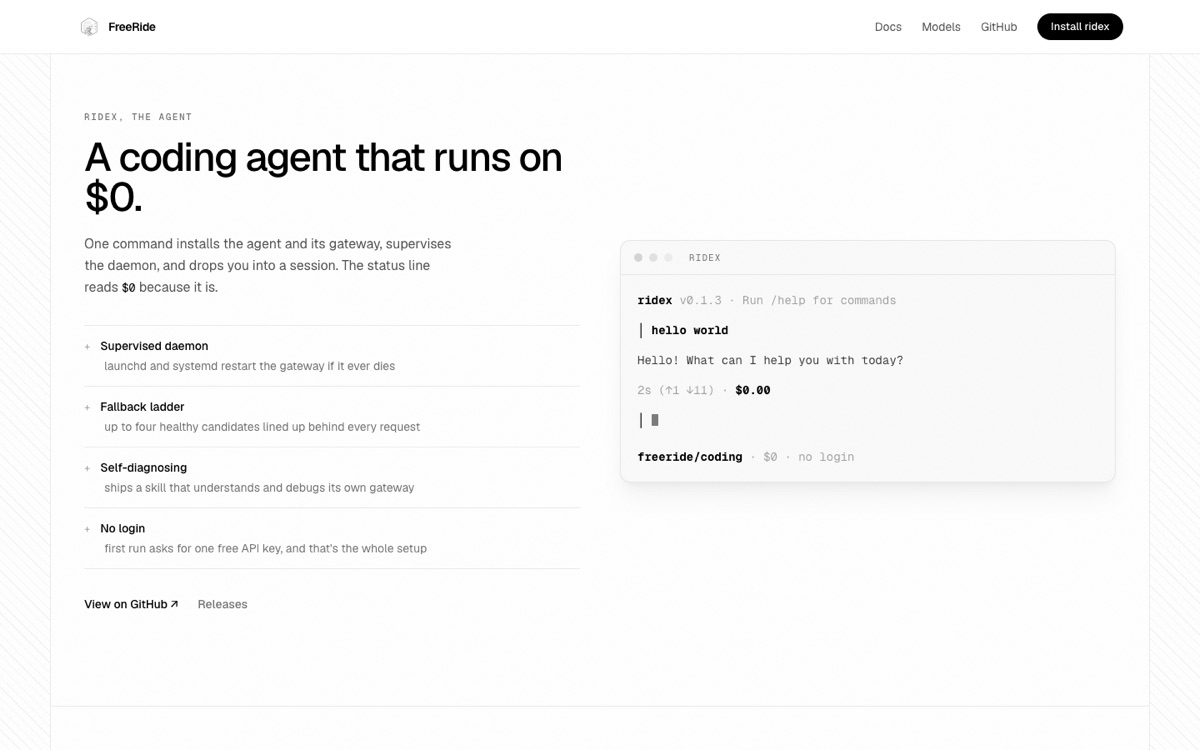 ridex, FreeRide's coding agent, runs in the terminal; its status line shows the session cost, $0. Screenshot: free-ride.xyz
The project says as much. The About page tells anyone needing SLAs, dedicated quota or guaranteed uptime to use a paid service, and says FreeRide is meant for free-tier development where occasional rate limits are acceptable. Its companion agent, ridex, is labeled experimental on GitHub: use at your own risk.
About ridex
Ridex is a coding agent, a fork of vercel-labs/fx, with FreeRide as its default provider. The repository sits under the GitHub user Shaivpidadi; the pages I have do not say who runs the project. The README says one free key is enough, and that setting FREERIDE_KEYLESS=ovh,blockrun lets it run with no key at all, using keyless fallbacks.
What the pages leave open
Several things go unsettled, and readers should not assume otherwise.
Data. The About page says requests go from your machine directly to the provider, and that FreeRide does not proxy traffic or see your prompts. It also describes a gateway that fans requests out across providers. The pages do not explain how both hold in practice. The models page says the project publishes a 30-day aggregate of OpenRouter token usage by model vendor, updated every six hours from OpenRouter's public app activity; in that table NVIDIA models lead the top-10 set at 55.2 percent. Ask for the setting called auto and the gateway uses those numbers, scoring models by failover headroom plus a popularity bonus. The same page says your traffic feeds routing decisions for everyone else, and lists beacon telemetry for other providers as a roadmap item. How usage statistics are gathered, and whether an install sends anything to the project, is not clearly explained. On this evidence I would not call FreeRide private, nor the opposite.
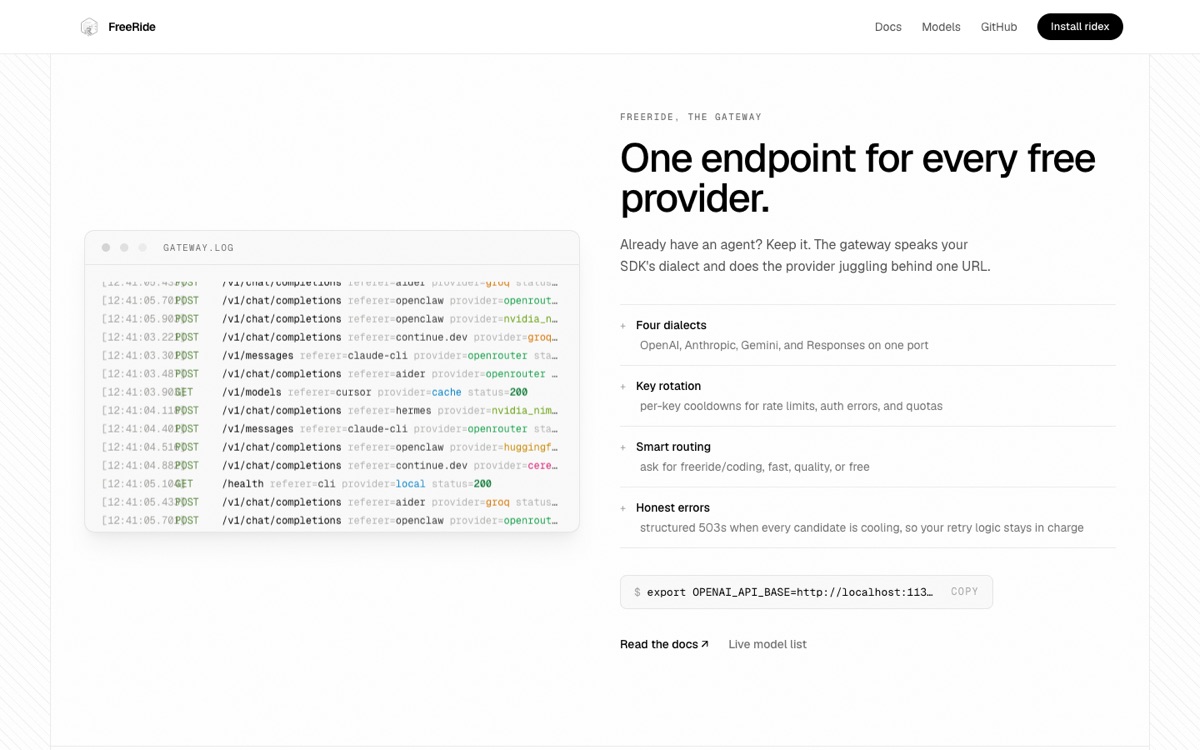 The gateway gives existing tools one local address and spreads their requests across free providers. Screenshot: free-ride.xyz
Provider terms. Free-tier rules differ by provider, and the pages do not address whether spreading requests across several providers and keys fits each one's terms. The About page says FreeRide respects free-tier limits, but that concerns rate limits, not terms of service. Check each provider's rules yourself.
Safety and track record. The sources include no security audit, no independent review and no user reports. The code is described as MIT-licensed and open on GitHub, so it can be read; nothing I have says anyone has read it critically. Piping a curl script into a shell, the install route shown, deserves care with any software.
The takeaway
As a mechanism, FreeRide is sensible: a local router that holds your own free keys and shuffles between them so one empty quota does not halt your work. In places where paid AI subscriptions are a real expense, India included, the appeal of free-tier tooling is obvious, though that is my context, not something these pages report about any users. The pages promise a coding assistant that keeps going at no cost. They also say, plainly, that it keeps going only until the free tiers run dry. Then you get a 503 and a decision to make.